 Football Chess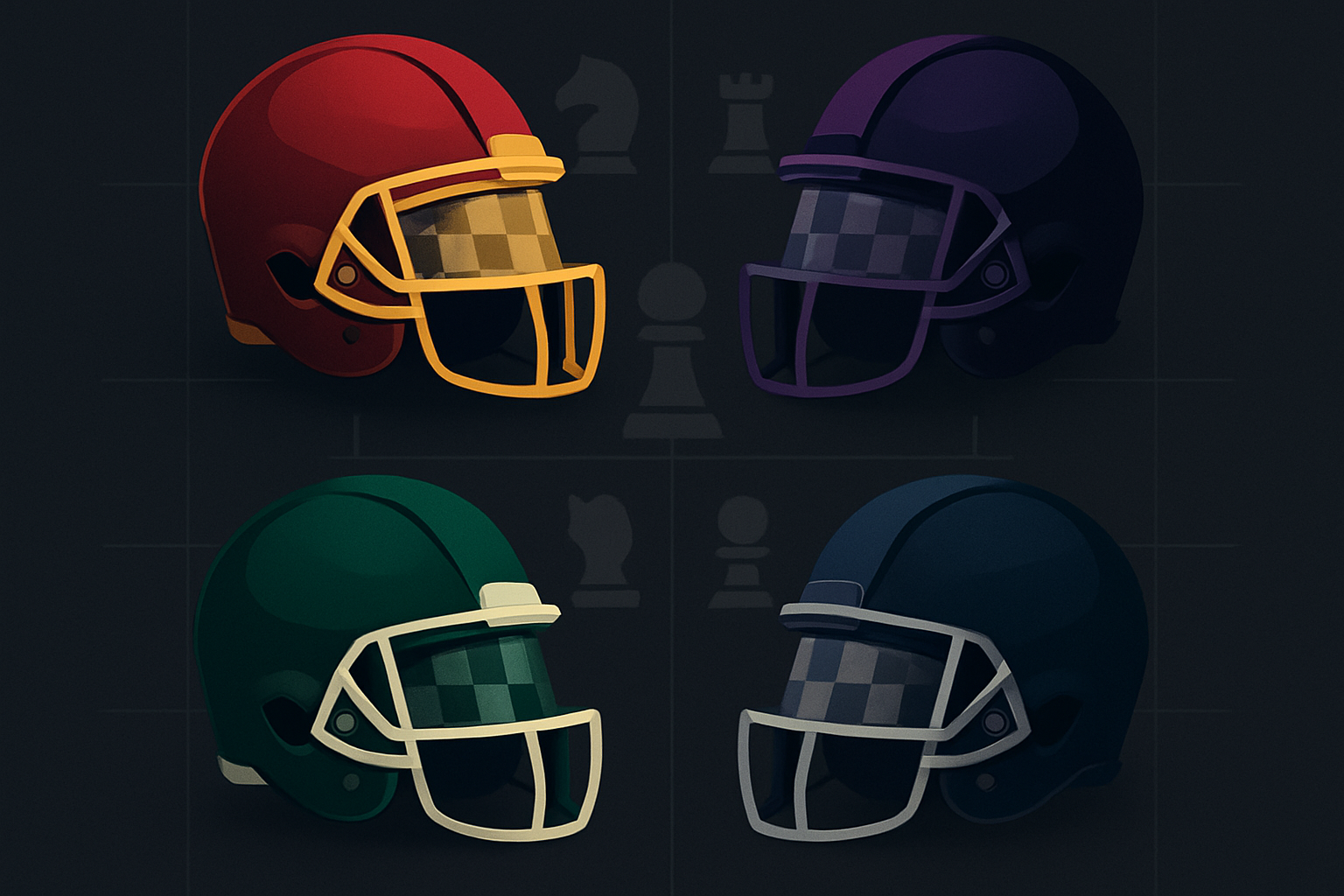
Which NFL Teams Play Football Chess Style?
Some teams play football like a video game. Others play it like chess.
The video game teams live on the spectacular — the deep ball, the broken tackle, the moment one player takes over and makes the defense look foolish. It's thrilling. It's highlight-reel material. And it depends on the kind of individual talent that doesn't show up in most cities most years.
Then there are the chess teams. Run-heavy. Methodically balanced. Addicted to formation variance. They move pieces with purpose. They control tempo. They make you react to them, not the other way around. When they're operating at full efficiency, they don't look exciting — they look inevitable.
Those are the teams that feel most at home on a Football Chess board. Here's a breakdown of four franchises whose real-world 2026 style maps directly onto the game's core mechanics.
San Francisco 49ers — Formation Variance
If Football Chess has one mechanic that rewards creative play above all else, it's formation flexibility. You can cluster your pieces tight for power, spread them wide for coverage stress, or run an asymmetric look that baits the opponent into overcommitting.
The 49ers have been running this philosophy out of Kyle Shanahan's system for years, and 2026 is no different. San Francisco doesn't have a "base" formation the way other teams do — they have a menu of formations, and they rotate through it based on down, distance, and defensive personnel.
The signature move is the pre-snap motion. A receiver shifts across the formation. A tight end goes in motion toward the backfield. And suddenly the defense has to communicate, re-identify, re-align. Do that fast enough and you can get a free yard before the ball is even snapped.
The Football Chess parallel: In the game, motion is how you exploit static defenses. When you move a piece across the board before committing to your main attack, you force your opponent to re-evaluate their position. The threat of the motion is often as valuable as the motion itself. Shanahan understands this at a molecular level. So does every strong Football Chess player.
Baltimore Ravens — Run-First Control
The Ravens are built around something most modern NFL teams have abandoned: a commitment to the ground game that functions as a strategic philosophy, not just a play-call preference.
Lamar Jackson makes this unique because he's a run threat himself — which means Baltimore effectively has a running back that can also throw a 40-yard strike. But the offensive line deserves equal credit. The Ravens invest heavily in their trenches, and that investment pays off in the most important currency in football: control of the clock.
Run the ball 32 times and you've also run 18–20 minutes off the clock. Your opponent's offense gets fewer possessions. Their pass rushers get tired. And your defense, which has been resting on the sideline, stays fresh deep into the fourth quarter.
The Football Chess parallel: Linemen are the most underrated piece type in the game. Beginners protect them like they're the most fragile things on the board. Strong players use them aggressively — advancing Linemen to control the center of the board, restrict the opponent's movement, and set up promotion opportunities. A Lineman that reaches the end zone becomes any piece you choose. The Ravens' offensive line strategy is exactly this: advance your big pieces deliberately, dominate the trenches, and let the board open up around them. Read more about Football Chess strategy to see how piece advancement works.
Philadelphia Eagles — Disciplined Clock Management
The Eagles in 2026 are a team that understands a simple truth: the team that controls the clock wins the majority of close games. Their offensive philosophy is built around possession — keep the chains moving, convert third downs, and bleed out the clock in the second half when you have a lead.
This is clock management as a competitive weapon, not just game-planning caution. Philadelphia will take the short gain over the big play when the situation calls for it. They'll go three receivers running routes at 8 yards on third-and-7 rather than launch a jump ball that turns the ball over on downs. Process over highlight. Efficiency over spectacle.
What makes this work is discipline: every player on the field knows the situation and executes within the system. There's no freelancing. There's no hero ball. When the Eagles are operating cleanly, they look like a machine.
The Football Chess parallel: In Football Chess, tempo is a real variable. You can play aggressively and put constant pressure on your opponent — or you can play conservatively, make only high-probability moves, and let your opponent make the mistake that costs them the game. Strong players read the board state and adjust their tempo accordingly. Late in a close game, a Football Chess player with the advantage should be playing Eagles football: don't gamble, protect the position, make your opponent take the risk. The short gain that keeps the drive alive beats the big play that falls incomplete.
Kansas City Chiefs — Situational Intelligence
The Chiefs are the hardest team to describe because their identity isn't about a formation or a philosophy — it's about reading the situation and adapting in real time.
Patrick Mahomes does something that very few quarterbacks in NFL history have been able to do: he processes defensive information before and during the play and makes decisions that are correct in the moment, not just on paper. When the designed play breaks down, he improvises something better. When the defense takes away his first read, he finds the third option without panic. He plays football the way a grandmaster plays chess — always thinking multiple moves ahead, always seeing the board in full.
The Chiefs also excel at situational football. Fourth-and-2 on the opponent's 48-yard line down 3 points in the third quarter? Mahomes doesn't just execute the call — he understands the call, why it was drawn up, what it's trying to accomplish, and what to do when it's not working.
The Football Chess parallel: The game rewards what you might call situational awareness — knowing not just what a piece can do, but what it should do given the board state. A Running Back that can fork two opponents is powerful. A Running Back that does that at the wrong moment and leaves your Quarterback exposed is a blunder. The best Football Chess players develop the same read-the-board instinct that makes Mahomes so difficult to defend. The piece moves matter less than the timing of the move.
Play Like These Teams Right Now
The Football Chess board is designed to reward exactly the kind of strategic thinking these franchises practice every Sunday. Run-heavy control. Formation variance. Clock discipline. Situational intelligence. These aren't just football concepts — they're the core mechanics of the game.
If you've been watching the 2026 season and thinking "I would have called that play differently," this is your game.
Play like the Chiefs — try Football Chess free →
Our AI bots range from rookie to elite — six difficulty levels, each with a distinct strategic identity. The Blitz bot comes out aggressive and sacrifices pieces for pressure. The Zone bot plays conservative and forces you to work for every yard. It's the best way to learn the game before you take on a real opponent.
Learn the pieces and how they move at /how-to-play/formations, or jump into the full Football Chess strategy guide to get a read on the advanced mechanics before your first game.
The teams above figured out what chess players have known for centuries: the side that controls tempo and space wins. Now you can run the same system.
{/* COVER IMAGE PROMPT (for openai-images gen -s 1536x1024):
"A clean, modern sports-editorial graphic showing four football helmets arranged in a 2x2 grid, each with a translucent chessboard overlay on the visor. The helmets are stylized and abstract — no team logos — in four distinct color schemes: red/gold, purple/black, green/white, and midnight blue/silver. Between the helmets, subtle chess piece silhouettes (knight, rook, bishop, pawn) integrated into the design. Background is a deep charcoal with faint grid lines, evoking both a chessboard and a football field diagram. Overall aesthetic: premium sports app graphic, bold and clean, no text in the image, no photorealism." */}