 Football Chess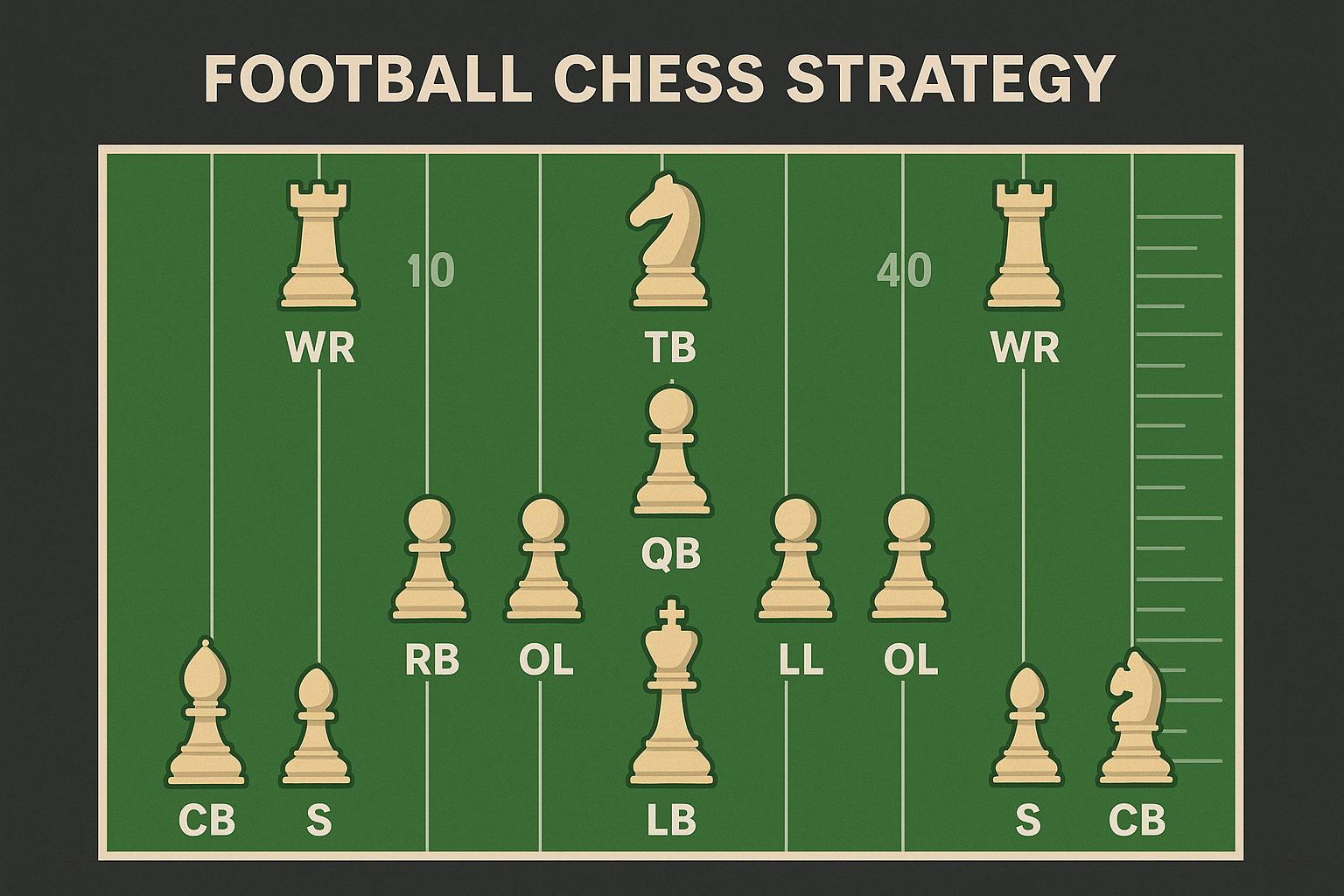
Football Chess Strategy: 5 Tactics Every Player Should Know
You've learned the rules. You've played a few games. Now you want to win more. Here are five strategic principles that separate beginner players from competitive ones in Football Chess.
1. Control the Line of Scrimmage
In real football, the team that wins the line of scrimmage controls the game. The same principle applies here.
The center of the board is your line of scrimmage. Pieces placed in the center have maximum range — they can attack in more directions and cut off more of your opponent's options. Linemen in the center are harder to dislodge than Linemen on the edges.
The move: Push your central Linemen forward in the opening. Aim to plant at least two Linemen in or near the center of the board by move 5. This gives your Quarterback and Wide Receivers room to operate.
Don't rush your Commissioner forward — that's how you get sacked.
2. Develop Your Running Backs Early
Running Backs (the chess Knight) are the most tactically complex pieces in the game. Their L-shaped movement lets them jump over other pieces and attack squares that no other piece can reach.
The key insight: Running Backs are almost always better in the center than on the edges. On the edge, a Running Back has 2-4 possible squares to move to. In the center, it has up to 8.
The move: In the first 4-5 turns, develop both Running Backs toward the center of the field. Don't just park them — look for squares where they threaten multiple opponent pieces simultaneously.
3. Set Up the Fork
A fork is when one piece attacks two opponent pieces at the same time, forcing your opponent to sacrifice one of them.
Running Backs are the best forking piece because their unusual movement pattern is hard to anticipate. A Running Back sitting quietly on one side of the board can suddenly jump to a square that attacks both your opponent's Commissioner and their Quarterback.
How to set it up: Look for a square your Running Back can reach (in one move) that would simultaneously threaten two high-value targets. If your opponent doesn't see it coming, you'll walk away with a free piece.
Wide Receivers (Bishops) can also fork along diagonals — especially when your opponent has clustered their pieces on the same color.
4. Protect the Commissioner with a Pocket
In football, the offensive line forms a pocket to protect the quarterback. In Football Chess, you want to do the same for your Commissioner.
An exposed Commissioner is one mistake away from checkmate. Before you launch attacks, make sure your Commissioner has escape routes — at least 2-3 squares he can move to if attacked.
The move: Castle your Commissioner to safety early (note: castling isn't implemented yet in the current version, so instead manually reposition). Move a Tight End to an adjacent column and keep a Lineman or two between the Commissioner and the front lines. Never let your protective pieces get traded away without replacing them.
A Commissioner in the center with no protection is a liability, not an asset.
5. Use Lineman Promotion as a Threat
Linemen that reach the opponent's end zone (the last rank) promote to any piece you choose — including a second Quarterback. This is a game-changing weapon that many beginners overlook.
The threat of promotion is often as powerful as the promotion itself. If you have a Lineman racing up the field with a clear path to the end zone, your opponent has to respond. That forces them to use moves defensively instead of attacking you.
The move: Look for a Lineman that's advanced past your opponent's front line. Ask: does it have a clear or semi-clear path to the end zone? If yes, keep pushing it. Your opponent will scramble to stop it — and that scramble opens up opportunities for your other pieces.
A second Quarterback (promoted Lineman) in your opponent's backfield is almost always a game-winning advantage.
Putting It Together
Good Football Chess is about coordination. It's not just about what one piece can do — it's about what three pieces can do together.
A classic combo: advance your Linemen to split the center, develop your Running Backs to fork pressure, and position your Wide Receivers on long diagonals that converge on the opponent's Commissioner. When those three threats operate simultaneously, your opponent is overwhelmed.
The best way to get better is to play, analyze, and play again. Start a game and try putting one of these tactics into practice this game.
Good luck out there. Touch down.