 Football Chess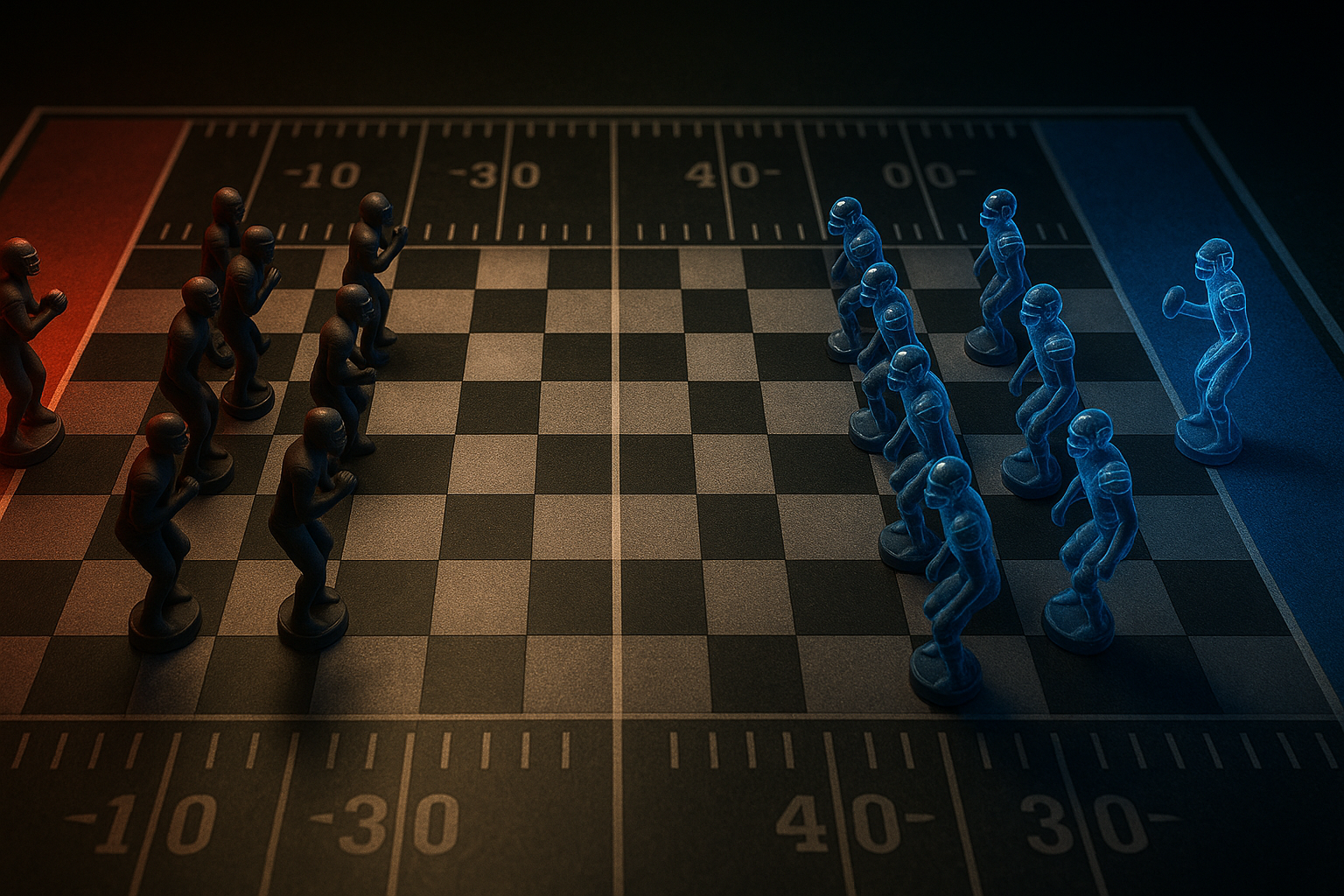
Can You Beat Our AI? Inside the Football Chess Bot System
When we launched Football Chess, one of the most common requests was simple: give me someone to practice against. Not just a random bot that moves pieces around — a real opponent with a strategy, one that forces you to actually think.
So we built one. Then five more. Then we ran them against each other 60 times in an arena to figure out which approach actually wins.
Here's what we learned.
The Arena: 60 Bot-vs-Bot Matches
We built six different AI strategies and let them play each other in round-robin format:
| Bot | Win Rate | Avg Points Scored | Avg Points Allowed | |-----|----------|-------------------|--------------------| | beam-offense | 61.9% | 8.7 | 1.7 | | greedy | 57.1% | 5.7 | 5.1 | | minimax-3 | 52.4% | 8.9 | 1.6 | | minimax-tuned | 52.4% | 8.0 | 1.7 | | minimax-2 | 42.9% | 5.8 | 2.6 | | random | 14.3% | 1.2 | 10.9 |
The winner? Beam search for formation placement — an AI that plans its starting lineup 3 moves ahead to maximize scoring lanes before any piece moves.
But the most interesting finding wasn't who won overall. It was how they won.
Formation Intelligence Beats Raw Move Calculation
In regular chess, strong play comes from looking several moves ahead — calculating every possible sequence and picking the best one. That's called minimax search, and it works brilliantly because chess has a fixed starting position.
Football Chess doesn't. You choose where to put your pieces every game. That means the opening formation decision is as important as any move — and minimax, which only kicks in after pieces are placed, doesn't see it.
Beam-offense exploits this gap. During formation, it simulates hundreds of possible starting lineups, picking the one that creates the most scoring opportunities. By the time the actual game starts, beam-offense is already ahead — it has a structurally better board.
That's why it won 61.9% of matches even though minimax-3 outscored it on average points (8.9 vs 8.7) and allowed fewer points (1.6 vs 1.7). Minimax-3 is the stronger move calculator — but beam-offense built a better field position before the clock started.
Why Chess AI Doesn't Translate
If you've played chess against a computer, you've probably experienced the modern AI that calculates millions of moves per second and is essentially unbeatable. Football Chess AI can't work that way — and that's intentional.
The reason is branching factor. In chess, each position has roughly 30 possible moves. In Football Chess, the formation phase creates thousands of starting configurations, and each position in the game has far more possible moves (every piece can move to multiple squares in multiple directions). Monte Carlo Tree Search — the technique behind AlphaGo and modern chess AI — needs millions of random game simulations to work. With Football Chess's branching factor, those simulations just tell you "lots of things can happen" without actually teaching the AI anything useful.
We tried it. Our mcts-heavy bot (500 simulations per move) won only 19% of matches — barely above random. More simulation didn't help because random Football Chess outcomes are too noisy to learn from.
The winning approach — beam search + adversarial verification — looks ahead in a structured way: not "what could happen in 1,000 random games" but "which of my top 4 plans holds up when the opponent plays their best response."
What This Means for Difficulty Levels
We're building four difficulty tiers based on these findings:
Easy — plays a random starting formation, makes unpredictable moves. Good for your first few games.
Medium — uses smart formation placement but makes moves based on immediate scoring opportunities. Will punish obvious mistakes.
Hard — combines formation intelligence with adversarial move analysis. It doesn't just try to score — it actively tries to shut down your scoring lanes.
Expert — reads the game state and shifts strategy mid-match. If it's ahead, it plays aggressively. If it's behind in the final third, it locks down and plays for defense.
None of these difficulty levels just "lets you win." Even Easy makes intentional formation decisions. But they're calibrated to the actual skill distribution of Football Chess players — so you'll have a genuine sense of progression as you improve.
Challenge: Beat the Arena Champion
Until the full difficulty system ships, you can practice against the current bots in Practice Mode. The best challenge: can you beat beam-offense with your own formations?
Here's the thing beam-offense taught us: your starting lineup matters more than any single move. Players who think carefully about formation placement before the game clock starts win a disproportionate share of matches — even against better in-game tacticians.
So the next time you set up your pieces, ask yourself: which formation gives me the most paths to score? Which pieces cover the most of the opponent's advance routes?
That's the beam-offense insight. Now use it.