 Football Chess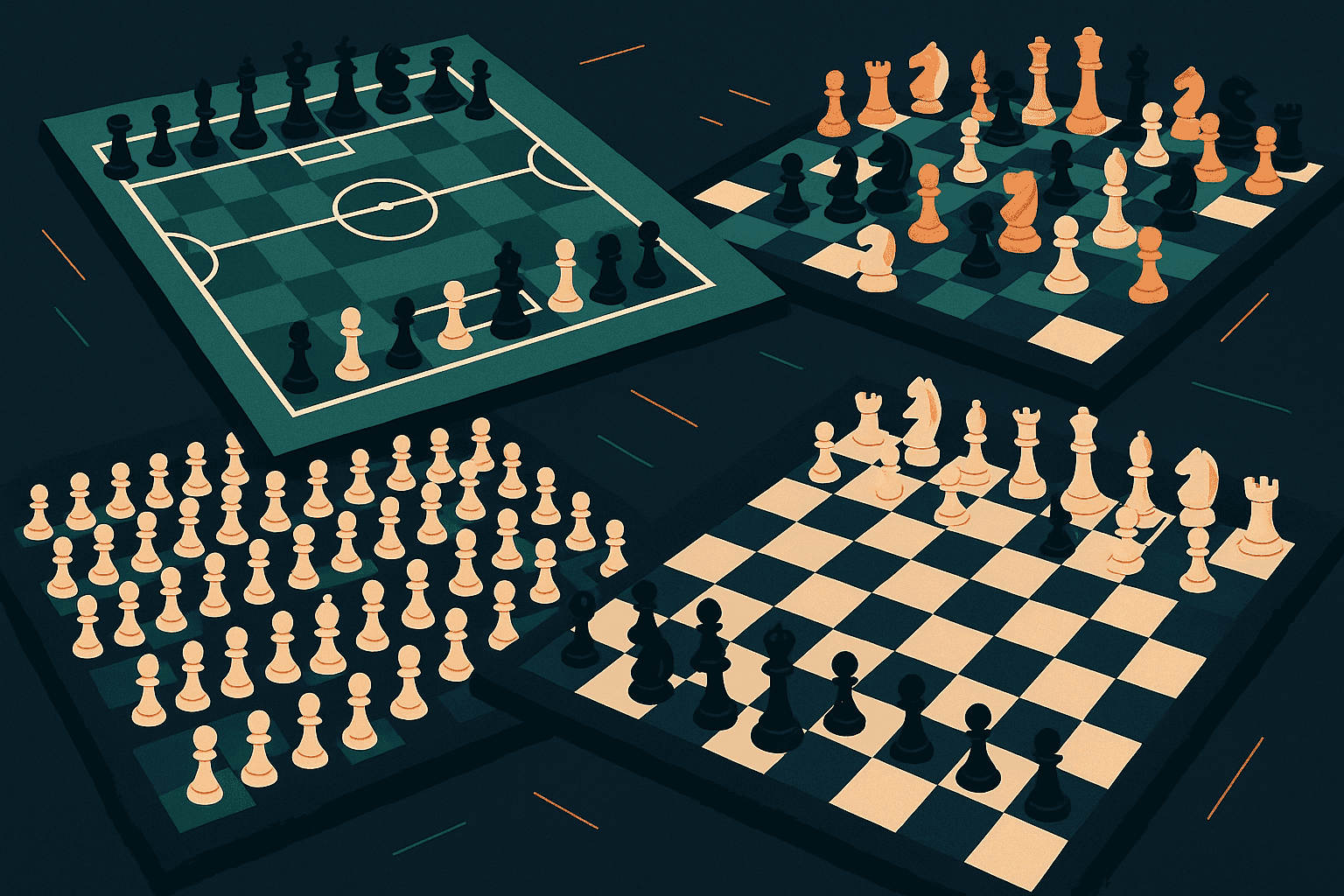
Chess Variants That Are Actually Fun for Non-Chess-Players
Here's the honest problem with chess: it rewards 20 years of memorized theory. If you didn't study openings as a kid, you're walking into a minefield every time you sit down with someone who did.
Chess variants fix this. They start the clock fresh. Nobody has 10,000 hours of theory on a variant that's three years old. The tactical depth stays. The gatekeeping goes.
If you've bounced off chess before, one of these might be the game that finally sticks.
1. Chess960 (Fischer Random Chess)
Who it's for: People who want real chess — but hate the opening game.
What's different: The starting position of the pieces on your back rank is randomized (with certain symmetry rules). There are 960 possible starting positions. Since your opponent doesn't know the "correct" response to your opening either, the game starts fresh for both of you.
Why it works for non-players: The endgame and middlegame in standard chess are pure skill. The opening phase, for beginners, is mostly theory you don't have. Chess960 eliminates that asymmetry. From move one, you're thinking — not trying to remember which line you're supposed to play.
Where to play: Chess.com, Lichess (both free, both have live opponents at all hours).
Learning curve: If you know standard chess, zero. If you don't, same as learning chess from scratch — but you'll be on equal footing faster.
2. Bughouse Chess
Who it's for: People who want chess to be chaotic and social.
What's different: Two chess games happen simultaneously on two boards, with two teams of two players each. When you capture a piece on your board, your teammate can place that piece on their board as their next move. Pieces flow between boards. Chaos is constant.
Why it works for non-players: Bughouse is fast, loud, and collaborative. You're not just playing against an opponent — you're communicating with your partner ("I need a rook!" "Hold on, hold on"). The social layer makes it feel less like a test and more like a game.
Where to play: Chess.com has Bughouse built in. Easiest to play in person with four people and two physical boards.
Learning curve: Requires knowing basic chess movement. Coordination with your partner is its own skill, but it's fun to learn.
3. Crazyhouse
Who it's for: The solo equivalent of Bughouse — same piece-dropping mechanic, one-on-one.
What's different: Pieces you capture from your opponent join your reserve. On any turn, instead of moving, you can drop a captured piece onto any empty square. Pawns can only be dropped on ranks 2–7.
Why it works: The game never runs out of steam. In standard chess, late-game positions can get dry — few pieces, long grinds. In Crazyhouse, every capture re-enters the game. Checkmates happen out of nowhere when someone drops a piece behind your lines.
Where to play: Lichess has the best Crazyhouse community. Free, no account required to play.
Learning curve: Mild. If you know chess, you'll pick this up in one game.
4. Antichess (Losing Chess)
Who it's for: Anyone who's ever wanted to intentionally play badly and have it work.
What's different: The goal is reversed. You're trying to lose all your pieces, or reach stalemate. Captures are mandatory — if you can take a piece, you must. First to no pieces (or stalemate) wins.
Why it works: It breaks the mental model of chess completely. Aggressive attacks become dangerous for the attacker. Your queen — usually your most valuable piece — becomes a liability you're trying to sacrifice. Strategic thinking still matters, but all your chess instincts run backwards.
Where to play: Lichess (search "Antichess"). Large active player pool.
Learning curve: Very low. You barely need to know chess to start — and your "bad" chess intuitions are suddenly useful.
5. Horde Chess
Who it's for: People who like asymmetric games — where both sides play differently.
What's different: One player has the standard chess set. The other player has 36 pawns — pawns only, covering the entire board below the midline. The standard player must capture all the pawns. The horde player must checkmate the king.
Why it works: It feels like a tower defense game on a chess board. The standard player charges forward aggressively, trying to carve through a wall of pawns. The horde player tries to overwhelm through sheer numbers. Both sides feel completely different to play.
Where to play: Lichess has a dedicated Horde mode with its own rating system.
Learning curve: Low. The rules are simple. The strategy is deep.
6. Football Chess
Who it's for: Sports fans who never got into chess — and chess players who want a completely new structure.
What's different: Chess pieces play American football. You select seven pieces each drive, line up at the line of scrimmage, snap the ball, and try to score touchdowns in four downs. Pieces move exactly as in chess — but instead of checkmate, you win by outscoring your opponent across four quarters.
The key mechanic: when a piece moves into another piece, it pushes it instead of capturing it. A push into your own ball carrier is a handoff. A push into an opponent is a tackle. Pieces don't disappear — they get pushed back.
Why it works: The football structure gives non-chess-players a framework they already understand. You know what a first down is. You know what a touchdown is. You know what a fourth-and-long feels like strategically. That familiarity lets you engage with the chess tactics underneath without feeling lost in an alien game.
For chess players: the formation-and-snap structure forces you to think in ways standard chess doesn't. You can't just react move-by-move — you need to plan drives.
Where to play: Football Chess is free at footballchess.com. No account needed, works in any browser. You can play against the computer or against other people online.
Learning curve: One game. The rules page walks you through everything in about five minutes.
Which One Should You Try First?
If you've never played chess and want an easy entry point: Football Chess (familiar football structure) or Antichess (low stakes, reversed goals).
If you know chess basics and want more chaos: Crazyhouse or Bughouse.
If you want chess to feel new but serious: Chess960.
If you want the most asymmetric, chaotic experience: Horde Chess.
The beauty of chess variants is that they're all free, they all run in a browser, and most games take under 30 minutes. There's no reason not to try a few.
Start with Football Chess →